
GitLab Ultimate: vulnerability report and policies
Everything on this page needs GitLab Ultimate. It was tried out on gitlab.com on 2026-10-27, in a public test project with a pipeline file full of deliberate findings. The screenshots show GitLab Ultimate, cropped to the part that matters. GitLab only shows the vulnerability report and the security widget to project members, so the screenshots have no link. glsec is an independent project, not affiliated with or endorsed by GitLab.
Findings in the vulnerability report
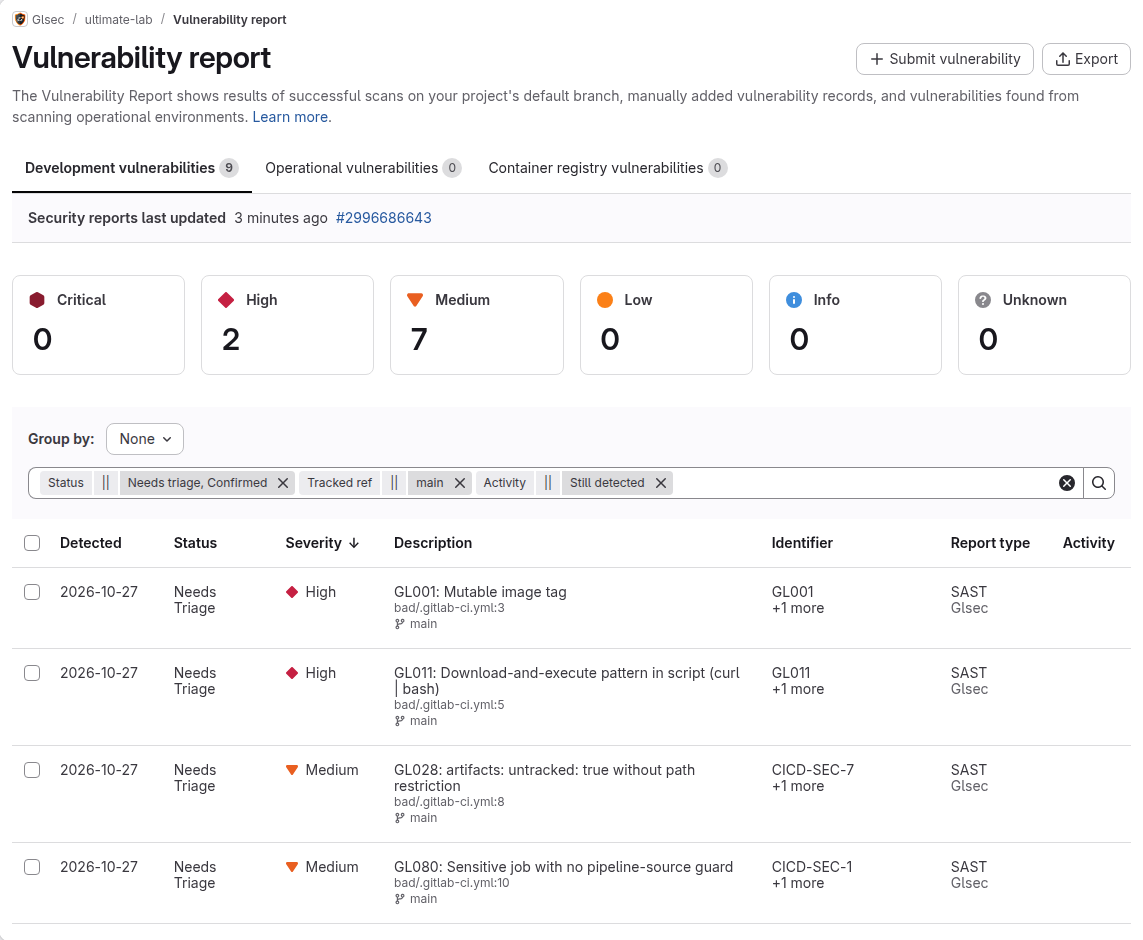
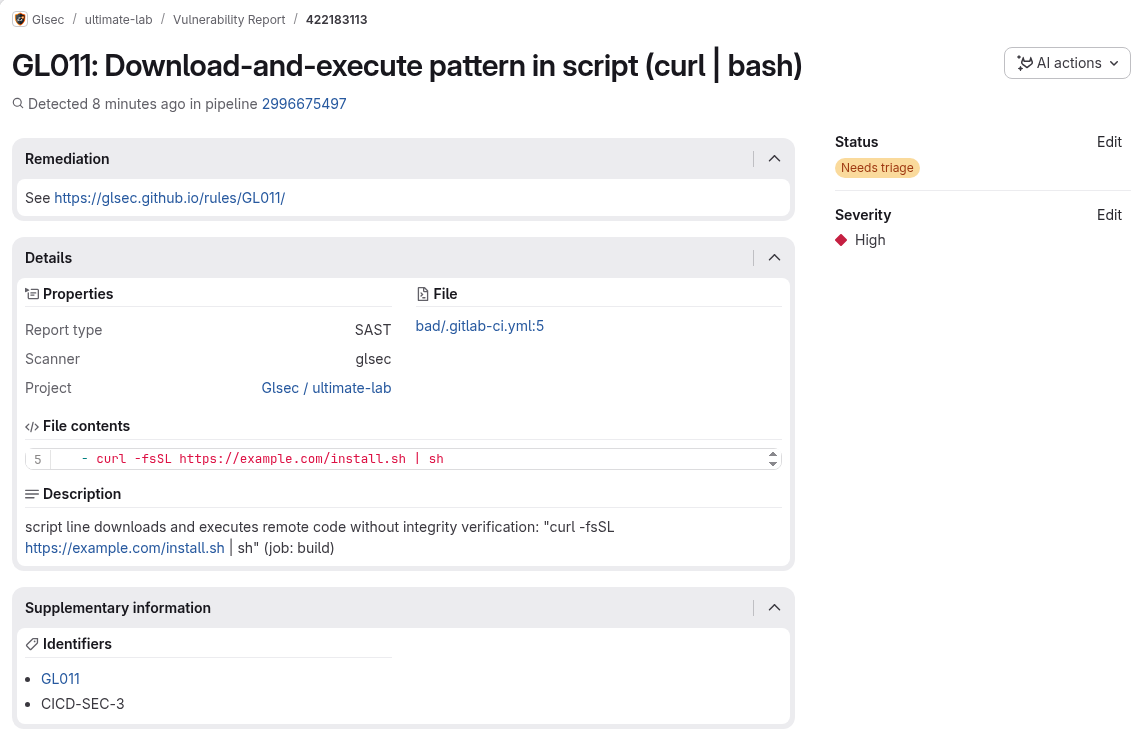
With --format gitlab-sast, glsec writes a SAST report in GitLab's security report schema. A job uploads it as artifacts:reports:sast (the job and an example report), and every glsec finding on the default branch becomes a vulnerability that can be triaged: confirmed, dismissed or linked to an issue. Error findings are High, warnings Medium, info Low.
In the merge request
The merge request's security widget lists the findings the merge request adds, compared with the target branch.

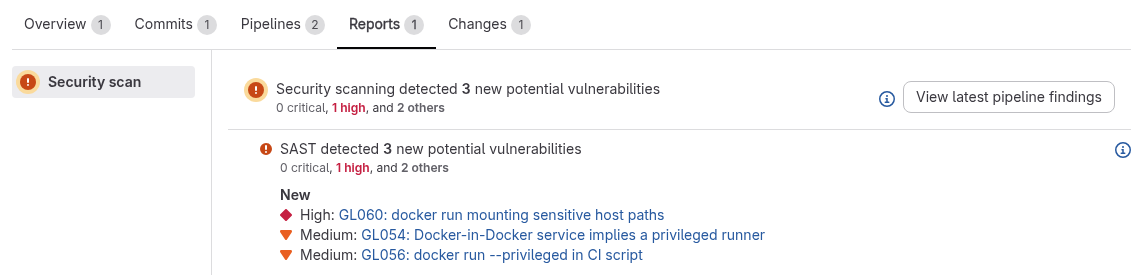
One limitation: GitLab matches a finding from one pipeline to the next by file and line. A merge request that adds or removes lines above an unchanged finding shows it as fixed and as new at the same time. A tracking signature in the report didn't change that in the test, so glsec's report has none.
Making glsec mandatory: a pipeline execution policy
A pipeline execution policy runs glsec in every pipeline of the projects it applies to, and the projects can neither remove it nor configure it away. Two files in the security policy project:
.gitlab/security-policies/policy.yml
pipeline_execution_policy:
  - name: glsec
    description: Lint .gitlab-ci.yml with glsec in every pipeline.
    enabled: true
    pipeline_config_strategy: inject_policy
    content:
      include:
        - project: my-group/security-policies   # this policy project
          file: glsec-policy.yml
          ref: main
glsec-policy.yml
include:
  - component: gitlab.com/glsec-io/glsec/glsec@v1.0.27
    inputs:
      version: "1.25.0"
      stage: .pipeline-policy-pre
      no_repo_config: true
      no_ignores: true
      strict: true   # optional: warnings fail the job too

# The policy configuration is evaluated on its own, without the project's
# workflow:rules. A job without rules: then runs only in branch and tag
# pipelines, so without this the merge request pipelines get no scan.
glsec:
  rules:
    - when: always
What it did in the test:
- The job runs in the reserved stage
.pipeline-policy-pre, before every project job. When it fails, the project's jobs are skipped. - A merge request that adds a
.glsec.ymlor a# glsec:ignorecomment changes nothing:no_repo_configandno_ignoresmake glsec ignore both, and the job log saysnote: .glsec.yml is ignored (--no-repo-config). - The component reference needs the
vof the tag (@v1.0.27). A reference GitLab can't resolve fails every pipeline of every project the policy applies to. - If a project has its own job named
glsec, GitLab renames the policy job toglsec:policy-<id>-0, and both run. - The policy also runs in branch pipelines that the project's
workflow:rulesdon't create, so a push to a merge request branch gets a branch pipeline with only the policy job, next to the merge request pipeline.
To upgrade, bump the component and version in the policy project; the projects don't change. The component README keeps the same example.
Scan execution policies and GL082
GL082 reports variables such as SAST_DISABLED that switch off GitLab's security scans. With a scan execution policy they don't: in the test, a policy running scan: sast on every branch still created its semgrep-sast-0 job after a commit that set SAST_DISABLED: "true", where the template include created no SAST job at all. So a scan execution policy is the way to make a scan mandatory, and GL082 still matters for projects and scans the policy doesn't cover. More in GL082.
Tiers as listed in GitLab's documentation for the vulnerability report, pipeline execution policies and scan execution policies. GitLab is a trademark of GitLab Inc.